11/26/2020 12:00:00 AM | Football
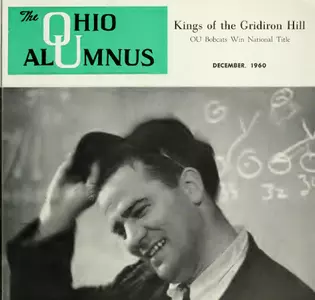
The following appeared in the December 1960 issue of "The Ohio Alumnus," written by Rowland Congdon. The PDF of the issue of "The Ohio Alumnus" can be found here.
OHIO UNIVERSITY'S 65th football season is history. And what history! Ten games played and ten games won!
The resulting 10-0 record was the best ever recorded by an Ohio University football team. Certainly there have been other undefeated seasons—four besides this one.
But the 1960 team was the only one to win 10 in one season. Others had a chance to do this, but none ever did.
The other undefeated records were in 1918 (4-0-1), 1929 (9-0-0), 1930 (8-0-1), and 1935 (8-0-0).
Ten games in 1950 resulted in a 6-4 mark followed by 1951's 5-4-1. These were the only other 10-game seasons.
So, undeniably, it was the greatest season record-wise in the history of Ohio U. football. And it brought the national "small college" championship.
What brought about this fine record?
Coach Bill Hess attributes it to "a dedicated coaching staff and a dedicated football team with lots of poise."
These, of course, were the end product of the efforts of many individuals.
Certainly the Bobcat booster organization, the Green and White Club, played a strong part in helping with many little things that keep morale high—such as pre-season outings on the Ohio River, a get-acquainted night at the Athens Country Club, providing jobs where needed, and hosting school athletes when they visit.
They also provided trophies awarded to the outstanding player each week and a trophy to the season's most valuable player.
Hess says he has never been with a harder working or more dedicated group of coaches than he has as his assistants. These are Frank Richey, backfield and overall defense; Cliff Heffelfinger, defensive line and tackles; Hugh Hindman, offensive line and guards and centers and in charge of the overall offense, and Bob Kappes, offensive and defensive ends and chief scout.
Reading over those assignments brings many questions as to what does Hess do? He is often heard to say that "I have trouble finding a chance to coach out on the practice field. I even wonder what worth I am on the sidelines during a game. Hugh runs the offense from the press box and Richey runs the defense from the sidelines."
But Hess is the organizing genius behind this dedicated group of individuals.
Each man knows his particular duties both on and off the field. Hess is a firm believer in writing out or charting duties, plays, performances both on the field of play and in the office. This allegiance to detail is one of the major factors in the team's success.
Of course, top-notch personnel have to be available both on the playing field and in the office to carry out the program to a successful conclusion. The coaching staff takes pride in the fine young men comprising the team. The sterling qualities of the staff rubbed off onto this team.
Hess or one of his assistants often say that they have never seen a team with as much chance to have senioritis as this one demonstrate the poise and dedication to a common goal of the 1960 Bobcats.
Fifteen seniors were on the squad, eight of them starting.
During a 10-game schedule, including three "major college" squads, situations often arise where individuals with less poise or esprit de corps will fail to achieve their
goal. But not the 1960 Bobcats. They displayed these assets to the utmost.
There were many times dining the season when pressure could have taken its toll of a less-poised team.
Probably the first time was the third game of the season, at Kent State. The Flashes wanted to atone for last year's 46-0 thumping at the hands of the Bobcats at Athens.
Taking the opening kickoff, the Bobcats marched 48 yards in six plays with Harrison scoring from 20 yards out. After only three minutes of play the score was 7-0. The second drive took longer, but in 18 plays the Bobcats had marched 73 yards to score from four yards out on a run by Brooks. With five minutes elapsed in the second quarter, OU led, 14-0.
OU held Kent on downs and took over the ball on their own 49 yard line. John Dickason, senior halfback gained six yards to the Kent 45. Then Bob Harrison, senior halfback, scooted over left tackle 45 yards for a touchdown on the Bobcats' second play from scrimmage. Senior End George Belu's placement was good.
On the Bobcats' second chance at the ball they scored again, going 80 yards in 12 plays to make the score read 14-0 at the end of the first quarter. This took some of the wind from Kent's sails.
Belu's 30-yard field goal midway through the second quarter gave the Bobcats a 17-0 halftime bulge. They went on to win, 25-8. Pressure-pot number one cooled off.
Next came the trip to Boston University, a "major" Eastern power. The Bobcats were favored in some circles, but staid Boston newsmen were skeptical of this "small college" upstart from the Midwest, likening itself to Ohio State.
Using mostly third-stringers the second half, OU won 36-6. Pressure-pot number two was cooled off.
Another major opponent was coming up, Xavier, at Cincinnati. Here again the Bobcats were pressured into showing that they were better than their "small college" tag. Another factor added pressure to this game—weather.
Soon after the game started, a thunderstorm hit and lasted most of the rest of the game. The Bobcats were able to score midway through the second quarter on Senior Fullback Bob Brooks' 14-yard blast up the middle. After that, however, offenses of both teams were bogged down in the heavy footing and OU was fortunate to gain a 6-0 win.
Then, the pressure-pot was brewed to the boiling point. Next opponent—Miami.
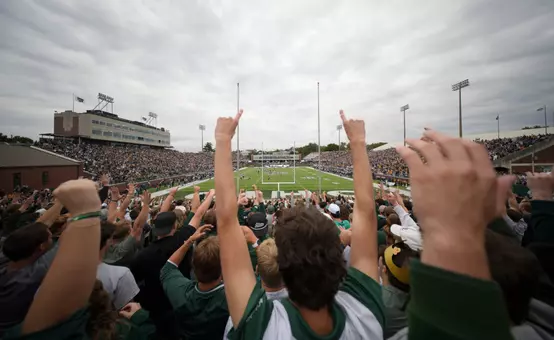
An Ohio University football team had not beaten Miami since 1942. The 1953 team tied them for the closest to a win in that span. The largest crowd in Ohio University history was in attendance—15,308. It was also the dedication game of the stadium as Don C. Peden Stadium. None of this seemed to bother the Bobcats—least of all the opposing Miamians.
They went on to win, 21-0. A steaming pressure-pot number three was softened to nothing.
Hess' first major goal of the season was accomplished - beating Miami.
A minor pressure-pot surrounded preparations for Western Michigan. They had lost to Bowling Green and Miami each by one point. The Bobcats made short work of this steaming cauldron. A 17-yard field goal by Belu opened the scoring, 3-0. Midway through the second quarter. Brooks plunged from the one and it was 10-0 at the half.
OU scored twice in the third quarter, for the final tally of 24-0. Western was never able to penetrate closer than OU's 1 7-yard line the entire game.
The Championship Game
After the 19-0 win over Marshall, the climax of the season arrived—Bowling Green.
Sports Illustrated threw extra ingredients into the steaming cauldron by sending a reporter to Athens for a day and a half and then to Bowling Green to cover the game. The resulting story was in the following week's issue of the magazine.
It told of how OU once again arose to the occasion to prove it was the best "small college" team in the land. An overflow crowd of 11,660 were in attendance to see the top
two teams in the nation vie for the number one spot. Bowling Green was also protecting an 18-game winning streak.
The Falcons scored first to increase the pressure on the favored Bobcats as it had been the first time they were behind all season.
Shortly after, OU tied the score and at half-time it was 7-7.
OU scored early in the fourth quarter and were driving for another marker while holding the Falcons at bay to win, 14-7, almost certainly clinching the national title and winning their first Mid-American Conference Championship since 1953. Goal number two was accomplished—win the league title.
One more game remained—the Dads' Day encounter against Southern Illinois. Their only defeat had been to Bowling Green, 27-6. OU subdued them easier than expected, 48-6, to finish off as national champions and markup the school's best season ever. Goal number three accomplished - finish undefeated and win the national title.